For most homeowners, the terms "watts" and "amps" are tossed around without a clear understanding of what they actually measure. Yet these two electrical units are central to how safely and efficiently your appliances run. In simple terms, amps measure the flow of electricity, while watts measure the total power consumed. Getting them mixed up can lead to overloaded circuits, tripped breakers, or even fire hazards.
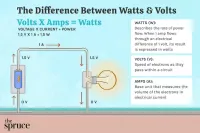
Amperage, or amps, quantifies the volume of electrons moving through a circuit. Voltage, on the other hand, represents the pressure pushing those electrons. Think of a garden hose: voltage is the water pressure, and amperage is the amount of water flowing. A circuit with high voltage but low amperage can still deliver the same power as a lower-voltage circuit with higher amperage. For instance, a 120-volt circuit pulling 10 amps carries the same volume of electrons as a 240-volt circuit drawing 5 amps.
This distinction matters for safety. Many electricians emphasize that amperage, not voltage, is the more dangerous factor when it comes to shock. The human body is more sensitive to current than to pressure. Regardless of the numbers, any live circuit should be treated as hazardous. Before working on electrical components, always disconnect the power and use a tester to confirm it's off.
Why Amperage Determines Circuit Strength
Amperage is the real workhorse of a circuit. While voltage sets the potential, the actual power delivered depends on the current, which is limited by resistance (measured in ohms). Lowering resistance allows more current to flow without increasing voltage. A useful analogy is pouring a bucket of water through a funnel: if you widen the spout, the water exits faster even though the same amount is poured.
Practical examples of amperage are everywhere. Battery chargers for 12-volt car batteries often offer settings like 2, 4, or 6 amps. Choosing a higher amp setting speeds up the charge, while a lower setting provides a slower, gentler charge. Some chargers include a "maintain" mode that uses a trickle of current to keep a battery from dying while stored.
Wattage: The Power That Gets Work Done
Wattage is the rate at which electrical energy is used. One watt equals one joule per second. In the earlier example, both the 120-volt/10-amp and 240-volt/5-amp circuits produce 1,200 watts. Increasing either voltage or amperage raises the wattage, which is why wattage is the figure that matters when matching appliances to circuits.
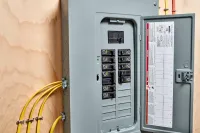
Every appliance has a wattage requirement. A 3,000-watt electric stove, for example, cannot run on a standard 120-volt, 10-amp circuit, which only provides 1,200 watts. It needs a 240-volt circuit with 15 amps, capable of delivering 3,600 watts. Overloading a circuit by plugging in too many devices can trip a breaker or blow a fuse, so understanding wattage is key to managing household loads.
Light bulbs offer a simple illustration. A 60-watt incandescent bulb on a 120-volt outlet draws 0.5 amps, while a 40-watt bulb draws about 0.33 amps. The lower-watt bulb has higher resistance, which reduces current and makes it dimmer. Using a bulb with a higher wattage than the fixture is rated for can damage the fixture and create a safety risk.
Calculating Watts and Amps
To find wattage, multiply amps by volts. To find amperage, divide watts by volts. To find voltage, divide watts by amps. These simple formulas allow you to verify that a circuit can handle the devices you connect to it.
There is no fixed number of watts in an amp; it depends entirely on the circuit's voltage. A 12-volt circuit with 10 amps produces 120 watts, but the same 10 amps on a 120-volt circuit yields 1,200 watts. Higher amps on the same voltage do mean more power, but the relationship between amps, volts, and watts is what ultimately determines electrical performance.
For anyone planning electrical work or simply choosing the right charger or bulb, grasping these basics can prevent costly mistakes and ensure safer operation. Always consult a licensed electrician for complex installations, and never exceed a circuit's rated capacity.